Grenada CBI Police Certificate: Who Needs It, Where to Apply, and How It Works
Published date:
December 25, 2025
Written by:
Radica Maneva
Reviewed by:
Inês Cabral Almeida
Our Editorial Standards:
We use the highest editorial standards at Movingto by ensuring every article is written by a qualified lawyer or immigration expert and fact-checked by a Portugal licensed lawyer. Learn more about our Editorial Process.
While many applicants treat police clearances as a routine formality, Grenada applies a much stricter due-diligence standard than most Caribbean programs.
Every adult family member is screened across multiple jurisdictions, with specific rules around age thresholds, residence history, certificate validity, fingerprinting, and authentication.
Submitting the wrong type of certificate, or missing a required country, can pause an application for months.
This guide explains who needs a police certificate, where it must be obtained, and how the process works in practice.
It also covers common edge cases, such as minors aged 16–17, dual citizens, applicants who lived in multiple countries, and jurisdictions like the United States or Hong Kong that require special procedures.
If you’re preparing a Grenada CBI application, getting the police certificates right from the start is one of the most important steps you can take to keep your file moving smoothly.
Key Takeaways
Updated 2025
16+ yearsPolice certificate age threshold
10 yearsLookback period
6 monthsMaximum certificate age
BiometricFingerprint-based checks
Who must submit
All applicants and dependents aged 16 or older must provide police certificates, including spouses, parents, and qualifying siblings.
Multiple countries apply
Certificates are required from countries of citizenship and from every country of residence during the last 10 years.
Six-month rule in practice
Although regulations reference one year, Grenada CBI due diligence typically expects police certificates after 6+ months of residence.
Country-specific formats
Some jurisdictions require specific documents, such as FBI checks (USA), ACRO certificates (UK), or government referral letters.
Not all records mean refusal
Minor or historical offences are not automatically disqualifying, but full disclosure and supporting explanations are essential.
Apostille required
Police certificates must be properly apostilled or legalized before submission; incorrect authentication causes delays.
Affidavits are a last resort
If a certificate cannot be obtained, an affidavit may be accepted—but this almost always triggers enhanced due diligence.
Sequence matters
Start slow jurisdictions early (e.g., USA, Hong Kong). Poor timing can cause documents to expire mid-application.
Who Must Submit a Police Certificate for Grenada CBI?
Grenada’s Citizenship by Investment program applies police certificate requirements by age, not by role.
This means the obligation does not stop with the main applicant—it extends to qualifying dependents once specific age thresholds are met.
Understanding who must submit a police certificate early is critical. Missing a required family member is one of the most common reasons applications are paused during due diligence.
Applicant type
Age threshold
Police certificate required?
From which countries
Fingerprints
Notes
Main applicant
16+
Yes (mandatory)
Citizenship + all residence countries (10-year lookback)
Yes
No upper age limit; always required
Spouse / registered partner
16+
Yes (mandatory)
Citizenship + residence countries
Yes
Treated the same as the main applicant
Dependent children
16–17
Yes
Citizenship + residence countries
Yes
Often overlooked; still required even if legally a minor
Adult dependent children
18+
Yes
Citizenship + residence countries
Yes
Also subject to oath requirements
Dependent parents / grandparents
16+
Yes
Citizenship + country of residence
Yes
Advanced age does not exempt applicants
Unmarried siblings (no children)
16+
Yes
Citizenship + residence countries
Yes
Only allowed under specific program conditions
Applicants under 16
<16
No
N/A
No
Police certificates not required at this age
Which Countries Require Police Certificates for Grenada CBI?
For Grenada CBI, police certificates are required based on legal ties and meaningful residence—not casual travel.
You can determine the required countries by applying three simple rules.
The Three Rules That Matter
Police certificates are required from a country if any of the following apply:
You hold citizenship in that country
You were born in that country
You lived in that country for 6 months or more during the last 10 years
If a country meets any one of these criteria, Grenada will normally require a police certificate from that jurisdiction.
What Usually Does Not Count
Police certificates are not usually required for:
Short stays under 6 months
Tourist or visitor trips
Business travel without residence status
Airport transit or stopovers
All stays must still be disclosed, but they do not trigger police certificates on their own.
Why the 6-Month Rule Is Used
Although some regulations reference a one-year threshold, Grenada’s due-diligence process follows international AML and background-screening standards, where 6 months of residence is considered material.
To avoid follow-up requests and delays, applicants should assume the 6-month rule applies in practice.
The Safe Approach
If there is uncertainty about a country, it is safer to obtain the police certificate upfront than to wait for a due-diligence query later.
Grenada’s Investment Migration Agency prioritizes completeness over speed, and missing jurisdictions are one of the most common causes of application delays.
Country type
Police certificate required?
Notes
Country of citizenship
Yes
Applies to all current and former citizenships
Country of birth
Usually yes
Exceptions are rare and difficult to prove
Country of residence (6+ months)
Yes
Applies within the last 10 years
Short visits / travel
No
Must still be disclosed in application forms
How to Obtain Police Certificates by Country
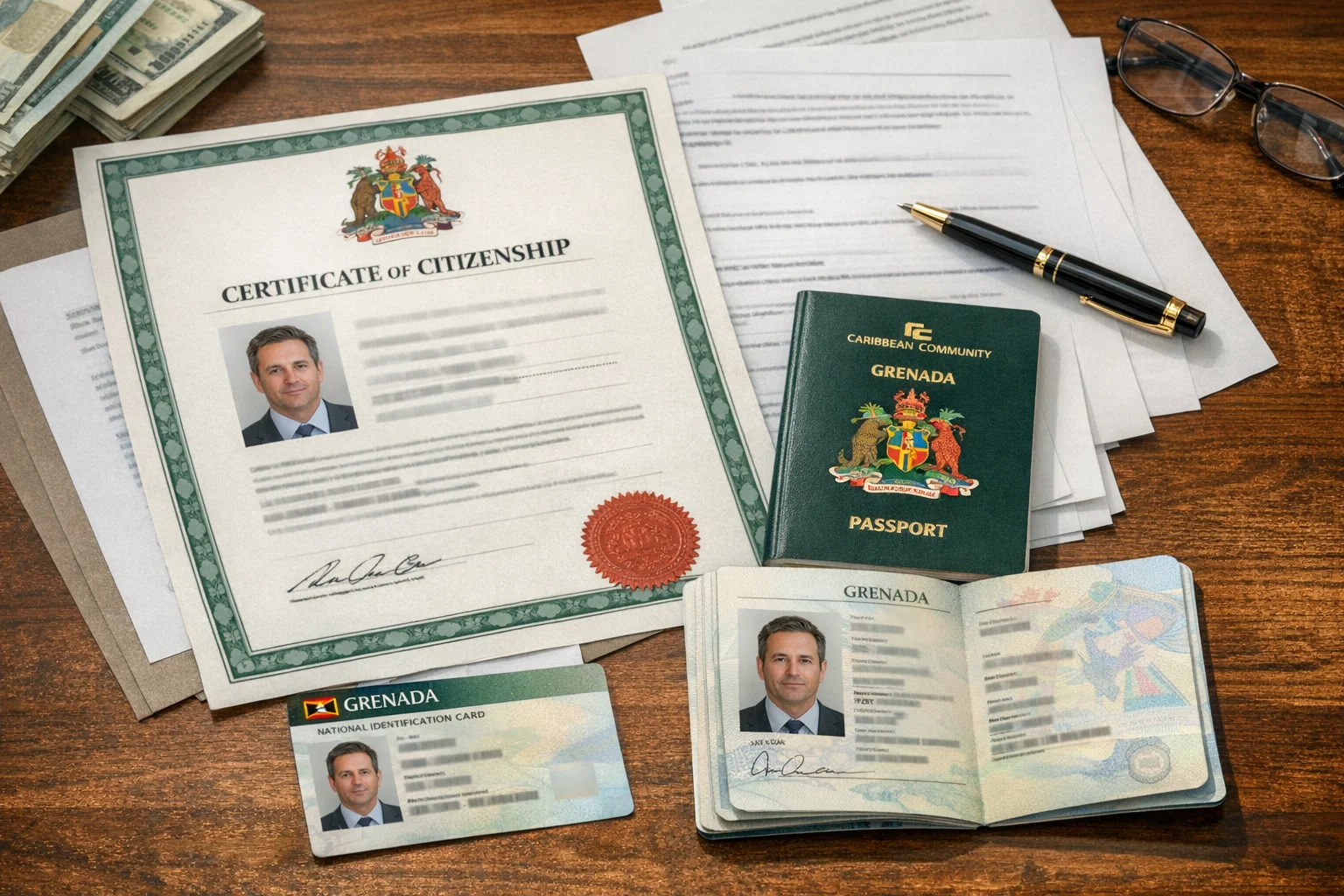
Certificate of Citizenship
Police certificate procedures vary widely by country.
Some issue records directly to applicants, while others require fingerprints or government referral letters or send results straight to Grenadian authorities.
Below are the most common jurisdictions encountered in Grenada CBI applications and how each works in practice.
Country / jurisdiction
Certificate type required
Who needs it
Fingerprints
Special rules
Notes
United States
FBI Identity History Summary
Citizens and residents (6+ months)
Yes
Federal apostille only
State or local police checks are not accepted
United Kingdom
ACRO Police Certificate
Citizens and residents
No
UK FCDO apostille required
DBS checks are not valid for CBI
Canada
RCMP Certified Criminal Record
Citizens and residents
Yes
Fingerprint-based only
Name-based checks are insufficient
Hong Kong
Certificate of No Criminal Conviction
Former residents
Yes
IMA referral letter required
Certificate sent directly to Grenada
Singapore
Certificate of Clearance
Citizens and former residents
Yes
Proof of foreign authority request
Physical fingerprints often required
Grenada
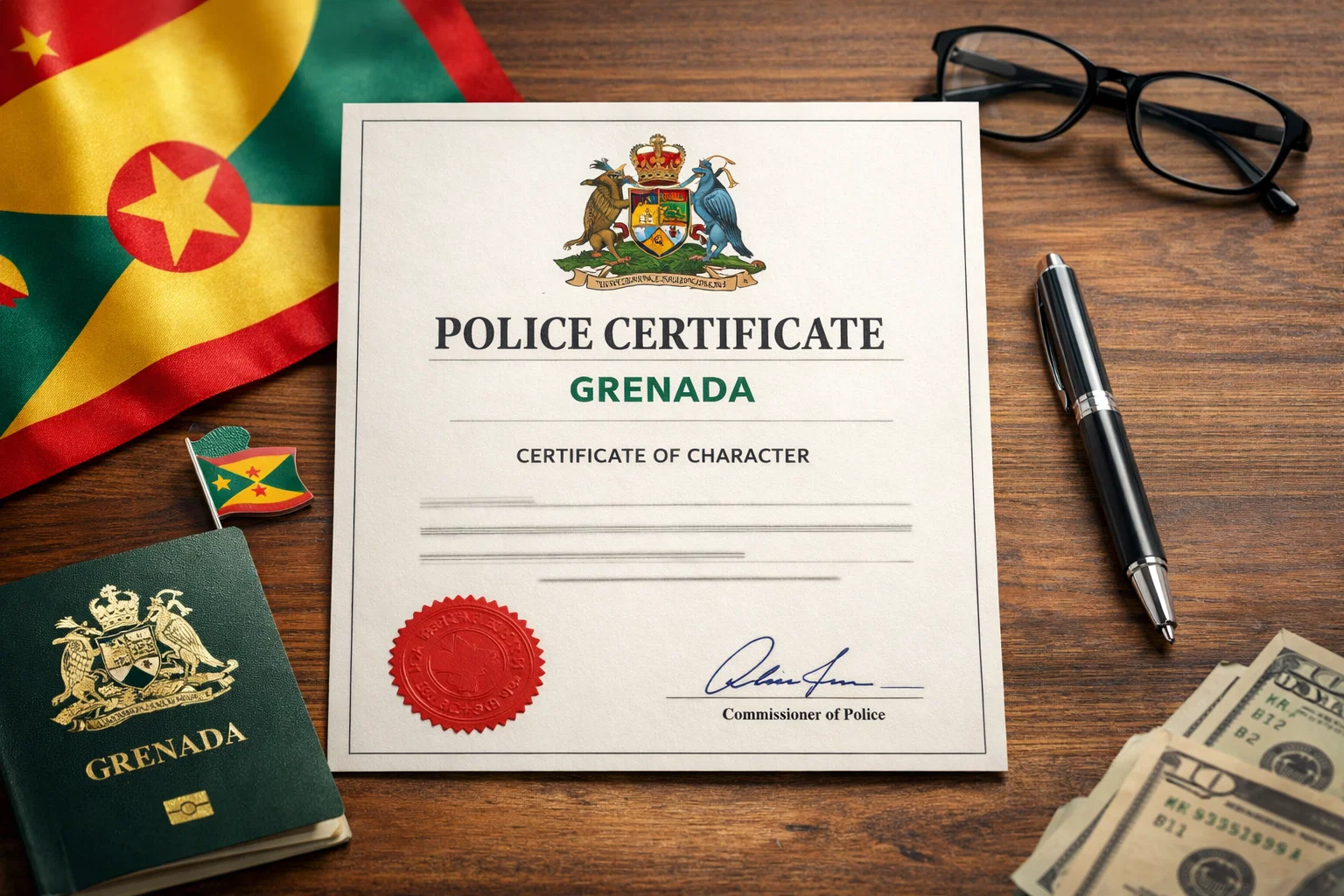
Police Certificate of Character
Former residents
Yes
Issued by local police authority
Applies to students and long-term residents
Other countries
National police certificate
Citizens and 6+ month residents
Varies
Apostille or legalization required
Format depends on local law
Validity, Apostilles, and Translations: Getting the Format Right
Correct Police Certificate
Obtaining the correct police certificate is only half the requirement.
For Grenada CBI, format errors, not criminal history, are one of the most common reasons applications are paused during due diligence.
Regardless of the source of the certificate, Grenada's Investment Migration Agency enforces strict rules on validity dates, authentication, and language.
Police Certificate Validity Period
Obtaining the correct police certificate is only half the requirement.
For Grenada CBI, format errors, not criminal history, are one of the most common reasons applications are paused during due diligence.
Grenada’s Investment Migration Agency applies strict rules on validity dates, authentication, and language, regardless of where the certificate was issued.
Police Certificate Validity Period
Police certificates must be recent at the time of submission.
Standard rule
Certificates must be issued no more than 6 months before submission to the Grenada CBI authorities.
If a certificate includes its validity period (for example, “valid for 90 days”), that shorter validity overrides the general rule.
Why this matters
Police certificates are assessed as a snapshot of an applicant’s background. Even a perfectly correct certificate will be rejected if it is considered outdated.
Practical tip
Because some jurisdictions take weeks or months to issue apostille certificates, police checks should be started before medical exams or final application packaging.
Apostille vs Legalisation: What Grenada Requires
Grenada is a signatory to the Hague Apostille Convention, which simplifies document authentication, but only if the issuing country is also a member.
Apostille (Most Common)
If the police certificate is issued by a Hague Convention country, it must be:
Apostilled by the competent authority in the issuing country
Examples
United States: U.S. Department of State (for FBI checks)
United Kingdom: FCDO
Canada: Federal or provincial apostille authority (post-2024)
Apostilles confirm the authenticity of the issuing authority, not the content of the document.
Legalisation (Non-Hague Countries)
If the issuing country is not part of the Hague Convention, the certificate must usually go through:
Local notarisation
Authentication by the country’s Ministry of Foreign Affairs
Legalisation by the Grenadian consulate or relevant diplomatic mission
This process takes longer and must be planned carefully.
Certified Translations (When Required)
Grenada’s official language is English.
Any police certificate not issued in English must be accompanied by a certified translation.
Translation requirements
Completed by a professional translator
Includes a signed statement confirming accuracy
Clearly references the original document
The translation must be submitted together with the authenticated police certificate.
Uncertified or informal translations are routinely rejected.
Common Format Mistakes That Cause Delays (Grenada CBI)
Submitting the wrong certificate type
Local or state checks (e.g. U.S. state police, UK DBS) instead of the required national certificates are not accepted.
Incorrect apostille or legalisation
Apostilles issued by the wrong authority (e.g. U.S. state instead of federal) routinely trigger rejection.
Expired certificates at submission
Police certificates must generally be issued within the last six months; older documents are not accepted.
Fingerprint requirements overlooked
Jurisdictions such as the U.S., Canada, Hong Kong, and Singapore require fingerprint-based checks.
Missing certified English translations
Any police certificate not issued in English must include a certified translation; informal translations are rejected.
Missing required countries
Failing to include all citizenship or 6-month residence jurisdictions commonly leads to due-diligence queries.
Identify all required jurisdictions: countries of citizenship, country of birth, and any country lived in for 6+ months in the last 10 years.
Step 2 (Immediate)
Prioritise slow jurisdictions first—typically the USA (FBI), Hong Kong, and Singapore—to avoid timeline bottlenecks.
Step 3 (1–2 weeks)
Complete fingerprinting where required. Use a qualified provider to avoid rejections due to poor print quality.
Step 4 (2–8 weeks)
Apply for the correct police certificate format in each jurisdiction (e.g., FBI Identity History Summary, ACRO, RCMP).
Step 5 (2–12 weeks)
Apostille or legalise each certificate through the correct authority. This step often takes longer than issuance itself.
Step 6 (3–7 days)
Obtain certified English translations for any certificates not issued in English. Attach translations to the authenticated originals.
Step 7 (Final review)
Confirm all certificates fall within the 6-month validity window and cover every required country before submission.
Step 8 (Submission)
Submit police certificates with the Grenada CBI application to avoid due-diligence queries and stop-start processing.
FAQs
All applicants and dependents aged 16 or older must submit police certificates. This includes the main applicant, spouse, parents, and eligible siblings. Applicants under 16 are exempt.
Police certificates are required from every country of citizenship, the country of birth, and any country where the applicant lived for six months or more in the last ten years.
Although regulations reference one year, Grenada CBI applies the six-month rule in practice. Any residence of six months or more is usually treated as requiring a police certificate.
No. Grenada requires national-level police certificates. For example, the FBI Identity History Summary is required for the United States, and ACRO certificates are required for the United Kingdom.
Yes. Police certificates must be apostilled or properly legalised before submission. Certificates without correct authentication are not accepted by Grenada CBI authorities.
Police certificates must generally be issued within six months of submission. If a certificate has a shorter stated validity, that shorter period applies.
In rare cases, an affidavit may be accepted instead. However, this almost always triggers enhanced due diligence and longer processing times.
Not necessarily. Minor or historical offences are not automatically disqualifying, but full disclosure is essential. Failure to disclose is treated far more seriously than the offence itself.
While technically possible, submitting police certificates later often causes delays. The safest approach is to include all required certificates at the time of filing.
The most common mistakes are submitting the wrong certificate type, missing a required country, or failing to apostille documents correctly—each of which can delay processing by months.
Final Thoughts
In the Grenada Citizenship by Investment process, police certificates serve as a crucial component of Grenada's due-diligence framework.
Most delays, queries, and reissue requests don’t stem from criminal issues.
They come from format mistakes, missing jurisdictions, expired documents, or incorrect authentication.
Those problems are avoidable, but only if police certificates are approached as a sequenced process, not an afterthought.
The most reliable approach is simple:
Identify every necessary country upfront
Start slow jurisdictions early
Use the correct certificate type for each country
Apostille or legalise properly
Keep everything within the six-month validity window
When police certificates are prepared correctly from the start, the rest of the Grenada CBI application tends to move smoothly. When they are rushed or incomplete, even strong applications can stall for months.
If there is one takeaway to remember, it’s this: completeness beats speed.
In a program that places a premium on security and credibility, doing it right the first time is the fastest path to approval.
Pass Grenada CBI eligibility—confidently
Compare real applicant checklists with expert tips.
Know what meets the standard and what triggers questions.
Attorney-led, independent process for EU residency by investment. 2h weekday response. Fact-only fund directory — no investment advice.
2,500+ EU approvals • 4.8★ Trustpilot
How we reviewed this article
All Movingto articles go through a rigorous review process before publication. Learn more about the Movingto Editorial Process.
Written by:
Radica Maneva
Senior Immigration Editor
Radica is a Senior Editor at Movingto. She has worked for more than a decade at leading publications as an Editor across immigration and travel industries.
Radica is a Senior Editor at Movingto. She has worked for more than a decade at leading publications as an Editor across immigration and travel industries.
Inês is a licensed lawyer (Bar ID 61676P) specializing in immigration, corporate, and residency law. With over five years of experience, she helps clients navigate complex legal processes with clarity and confidence.
Movingto Community
Choose Your Country Community
Private groups moderated by our team—practical updates, lived experience, and trusted local insight.
Portugal
D7, D8, D2 and investment-route discussions with members on the ground.








.svg)